

Overview
A trigger, shown on the canvas as a Source, decides which files a workflow sees. Every file that reaches a source goes through the workflow once.
To add one, open the Nodes tab in the editor and pick it from Sources. Click the source on the canvas to open its settings.
Only owners and admins can add or change sources. Sources other than The Drive AI need the account connected in Settings > Integrations and a plan that includes connected accounts. See Plans & Pricing.
More than one source
One workflow can have several sources, for example The Drive AI, a Google Drive account and an Outlook inbox. They all share the same steps. Each file is handled in the place it came from: a file from Google Drive is moved and renamed inside that Google Drive. Add a second source when you want the same rules on more files. Use a separate workflow when the rules should differ.When a workflow mixes sources, every step has to work for all of them. For example, a workflow with an Email Attachment source needs a Save a Copy step before anything that moves or renames, even for files that come from a drive.
File Uploaded
Starts when a new file appears. Under Where, choose where to watch:- The Drive AI: files added to your workspace. Uploads, imports and synced files all count as new files.
- A connected account: a Google Drive, OneDrive, SharePoint or Dropbox account connected in Settings > Integrations.
- Every member’s Google Drive, OneDrive or Dropbox: each member’s own drive, in team workspaces. See Every member’s own drive.
Narrow it to a folder
Under Folder, choose:
A new File Uploaded source on The Drive AI starts on Root only, and one on a connected account starts on All folders. Root only suits a filing workflow, because a file someone already put in a client folder has already been filed by a person.
Google shared drives
If the Google account can reach shared drives, a Location list appears. Choose My Drive for the account’s own files, or a shared drive. When you pick a shared drive, anyone on the team who adds a file to it starts the workflow. It runs through this one account, so only that account has to stay connected, and nobody else needs to join.SharePoint sites and libraries
SharePoint has no single drive to watch. After you choose a SharePoint account:1
Choose the site
Under SharePoint site, search for the site by name, or paste a link to it.
2
Choose the library
Under Document library, choose the library. Anyone who adds a file to that library starts the workflow, through this one account.
3
Narrow it (optional)
Under Folder, choose All folders, Root only or Specific.
Skip duplicate files
Under More options, turn on Skip duplicate files to ignore exact copies of a file that’s already in the watched place or that this workflow has already handled. Only byte-for-byte copies count. A re-scan or re-export of the same document is a different file.File Updated
When you choose a Dropbox account under Where, the source shows as File Updated. Dropbox doesn’t say whether a file is new or edited, so this source runs for files that are added and for files that change. Its settings are the same as File Uploaded. A workflow doesn’t start again because of its own changes. Moving or renaming a file doesn’t send it back through the same workflow.On a Schedule
Starts at set times and goes through a folder, running the workflow once for each file it finds. Use it for rules about files that are already there, like archiving anything older than a year, or for tidying a folder every night.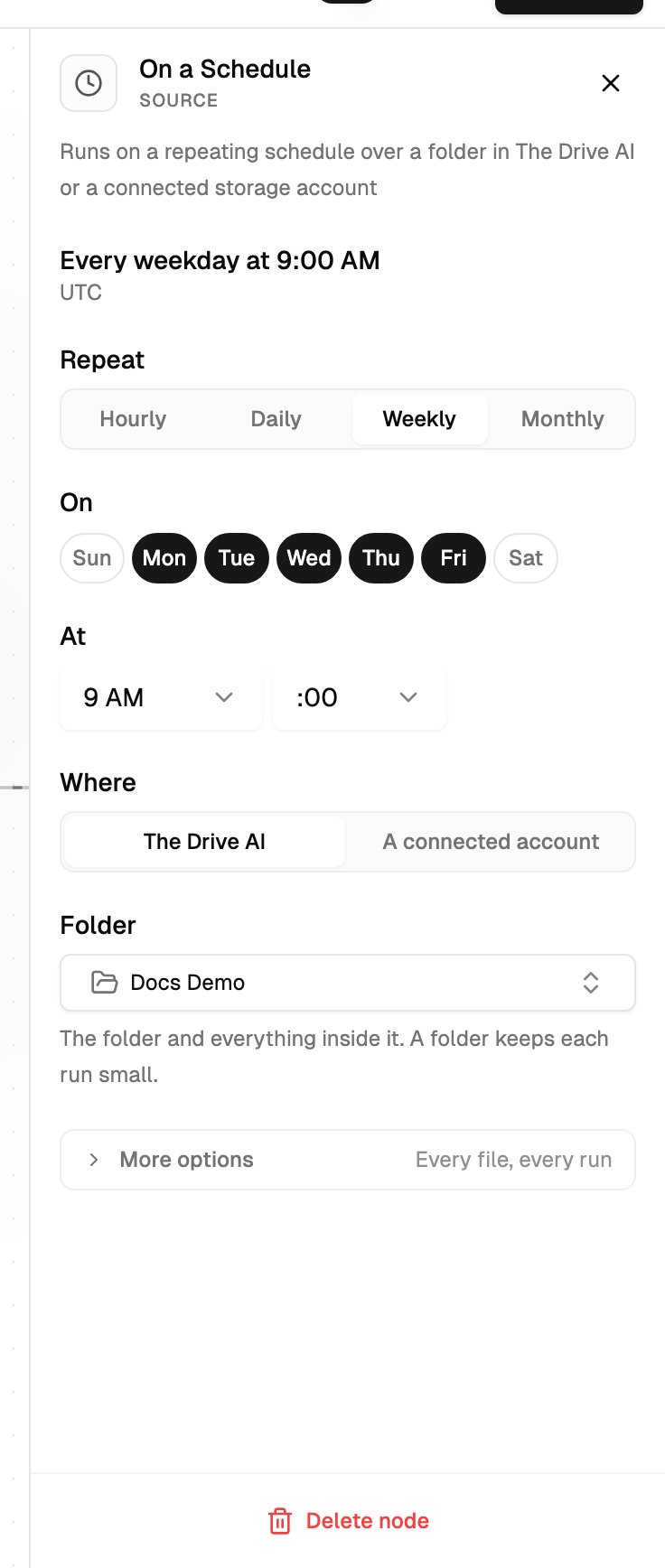
For The Drive AI, the folder is optional: leave it as Whole workspace to go through everything, though a folder keeps each run small. For a connected account, a folder is required. SharePoint asks for the site and library first, and Google Drive offers its shared drives under Location.
Which files each run goes through
Under More options, Each run goes through decides how much of the folder each run looks at:- New and changed files only: each file is handled once, then left alone until it changes. Right for keeping a folder organized. This is the default for a connected account.
- Every file, every run: right for rules about age, like “older than 90 days”, because those files aren’t changing. AI steps run again on every file each time. This is the default for The Drive AI.
Limits
- A schedule can run at most every 5 minutes. The picker’s shortest option is every hour. A schedule the agent wrote with a pattern the picker can’t show appears as a read-only Pattern, and still runs as written. Click Replace with a simple schedule to use the picker instead.
- Each run handles up to 200 files. A bigger folder is finished over the next runs, picking up where the last one stopped.
- Each file in each run counts as a workflow file.
Email Attachment
Starts once for every attachment that arrives in a connected Gmail or Outlook account. The email itself isn’t saved.- Account: the inbox to watch.
- More options > From: only attachments from senders containing this text, for example
@acme.comor part of a name. - More options > Subject contains: only emails whose subject contains this text, for example
Invoice.
- Mail that arrived before the account was connected, or while it was disconnected.
- Attachments brought in with Historical sync. See Email integration.
- Mail from a sender on the workspace Email Blocklist or the account’s blocked senders. These show in Activity as skipped, naming the address and the blocklist.
Slack
Starts when a file is shared in a connected Slack channel.- Workspace: the Slack workspace.
- Channel: one or more channels, or All channels. Only channels the app has been added to are listed. See Slack.
Microsoft Teams
Starts when a file is shared in a connected Teams channel.- Workspace: the Teams connection.
- Team and Channel: the team, then one or more of its channels, or All channels.
Every member’s own drive
In a team workspace, File Uploaded can watch each member’s personal drive instead of one account. Under Where, choose Every member’s Google Drive, Every member’s OneDrive or Every member’s Dropbox.- Each member’s files are organized inside their own drive. Nothing is moved out of it or copied anywhere else.
- Nothing runs on a member’s drive until that member joins. See Workflows that ask to use your account.
- Under Whose drives?, choose Everyone (including people who join the workspace later), Admins, or Specific people.
- Under Folder, type a folder path such as
Clients/Inbox. The same path is looked up on each member’s drive. A drive without that folder is watched once it appears. - One source covers one kind of drive. A member who hasn’t connected that service can’t join it. Add a second source for the other kind.
A folder that doesn’t exist yet
If the agent builds a source for a folder that hasn’t been created, the source waits. The panel says it’s waiting for the folder, no files are processed until it exists, and it starts on its own when the folder appears.What’s next?
Steps
Decide what happens to each file.
Approvals and activity
See what each source picked up.