

Overview
The agent can work directly in your Google Drive, OneDrive, SharePoint and Dropbox. It can find and read files, and move, rename, edit or organize them where they are. Nothing is copied into The Drive AI to make this work. Connected drives and accounts come with Max, Team, Business and Enterprise. On other plans, the agent works only on files stored in The Drive AI. See Plans & Pricing.Connect a drive
Any member of a workspace on one of those plans can connect their own account. Viewers can’t open Settings, so they can’t connect one.1
Open Integrations
Open Settings and choose Integrations. Under Cloud storage, click Google Drive, OneDrive, SharePoint or Dropbox.
2
Sign in
Click Connect Google Drive (or the button for your drive) and sign in to your account in the window that opens. Allow pop-ups if your browser blocks it.
3
Wait for cataloguing
The agent first builds a catalog of what’s in the drive. While it does, the account shows Agent: cataloguing. When it’s done it shows Agent: ready. This takes minutes for most drives, and longer for very large ones.
Work and school Microsoft accounts need your Microsoft 365 administrator to approve The Drive AI first. If you see Administrator approval is required, ask your administrator to approve access in Microsoft Entra, then click Check approval & finish connecting.
Personal drives and shared drives
Your own drive appears automatically. When you connect Google Drive (My Drive), OneDrive or Dropbox, the agent catalogs your drive. Only you can see it through the agent. Shared drives are added by an admin. A workspace owner or admin chooses which Google Shared Drives and SharePoint document libraries the agent catalogs:- Connect your own Google Drive or SharePoint account, one that is a member of the shared drive or library. You can only add a drive with an account you connected yourself.
- Open Settings > Agent, find your account under What the agent can see, and click Add shared drive (Google Drive) or Add library (SharePoint). Once the service is listed under Connected in the left sidebar, you can also point at it there and click +.
- Choose the shared drive from the list. For SharePoint, search for the site by name (or paste a link to it), then choose the library and click Add library.
- they’ve connected their own Google or Microsoft account in this workspace, and
- that account can open the drive in Google Drive or SharePoint.
Check what the agent can see
Open Settings > Agent and expand What the agent can see. When it’s folded, one line sums it up, for example Workspace files · 2 accounts · 48,210 items, or which drive needs a look.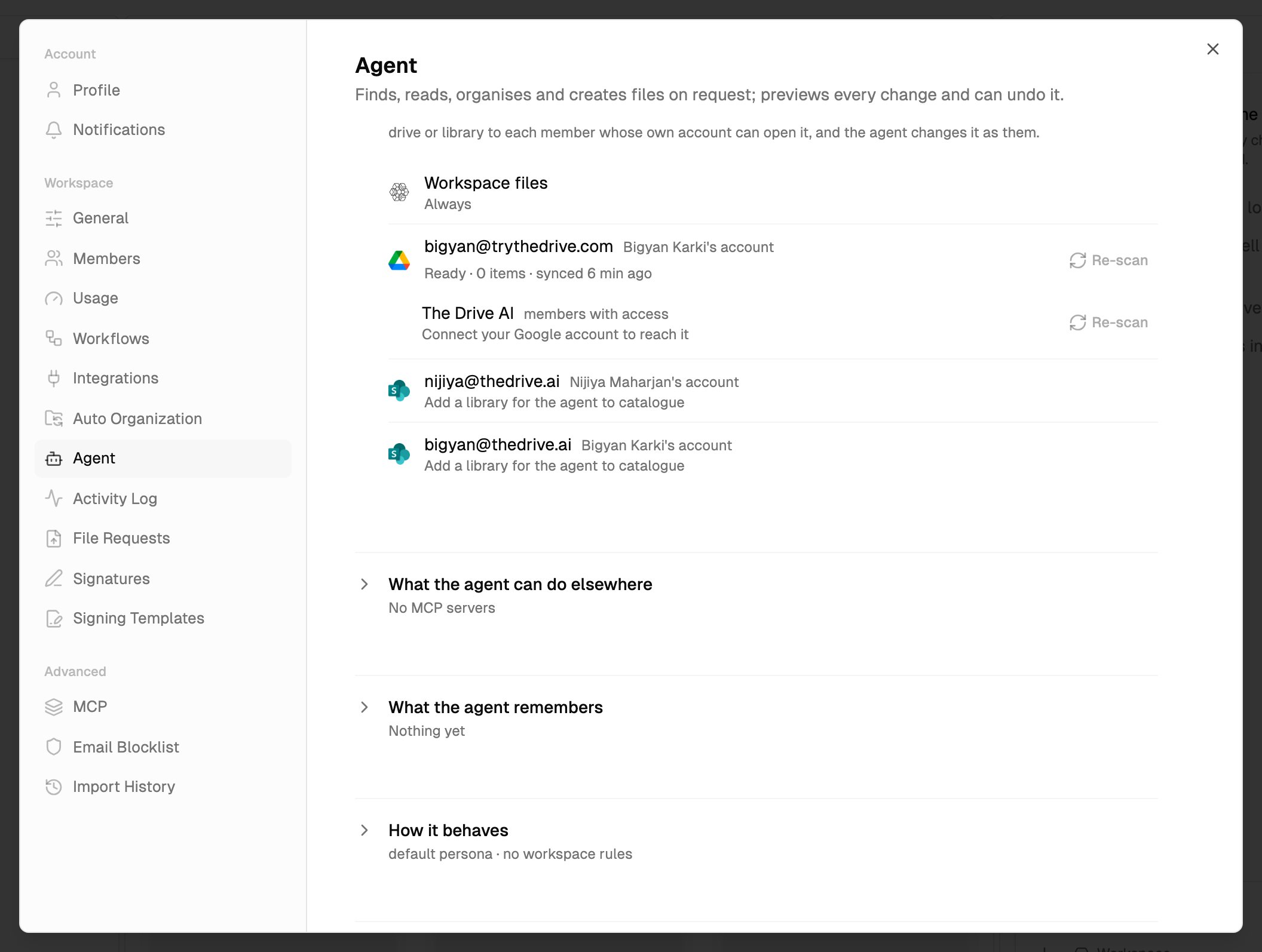
- Workspace files, marked Always: the files stored in The Drive AI.
- Each connected account, marked your account or with the teammate’s name, and a status line for its own drive.
- Shared drives and libraries under the account that catalogs them, marked members with access. If your account can only view one, it says members with access · you can view.
Under a shared drive, a line can also say why you can’t reach it:
Click Re-scan on a drive to rebuild its catalog, for example when it shows Stopped. It isn’t offered while a drive is still cataloguing.
For a SharePoint account, the line says Add a library for the agent to catalogue until a library is added, then how many libraries are catalogued. If the agent is turned off for the workspace, accounts say Catalogued once the agent is on.
Changes you make in the drive itself reach the agent within about a minute.
What the agent can do in a connected drive
- Find files by name, and by content using the drive’s own search.
- Read text files, PDFs, Word, Excel and PowerPoint files, and Google Docs, Sheets and Slides.
- Read audio and video recordings, on plans that include every file type. A recording is transcribed the first time you ask about it, which can take a minute or more, and the transcript is then searchable.
- Organize: move, rename, copy, create folders and move files to the drive’s trash.
- Edit documents in place: Google Docs, Google Sheets and plain text files such as .txt, .md and .csv. The card shows the change before it’s made, and undo puts back the earlier content.
- Save files it makes into a folder on the drive when you choose Save to a folder.
What it can’t do
- It can’t move or copy files between two different storages in one change, for example from Google Drive into The Drive AI, or from OneDrive to Dropbox. A workflow with a Save a Copy step can: it puts a copy of each file it handles into The Drive AI or another connected account, as files arrive or on a schedule over an existing folder. For a one-off copy, you can also use Import from Cloud and Export to Cloud (see Google Drive).
- It can’t read images stored in a connected drive. Images stored in The Drive AI are different: they are read when you upload them, on plans that include every file type.
- It can’t edit Google files that have no text form, like Slides decks and Drawings. Open those in Google Drive.
- It can’t move a file someone else shared with you out of their Google Drive folder. Files whose folder you can’t see are listed under Shared with me. The agent can copy them into a folder of yours instead.
- Search by content may miss scanned pages. The agent can read a scanned PDF when it opens it, but words that only appear in a scan may not be found by a search across the drive.
Undo on each drive
When the agent moves a file to a drive’s trash, whether Undo can bring it back depends on the drive:
Other changes, like moves, renames and new folders, can be undone on every drive. An edit to a document can be undone unless its earlier version was too large to keep a copy of.
Disconnecting
In Settings > Integrations, open the drive and click Disconnect next to the account. You can disconnect accounts you connected yourself. Owners and admins can disconnect anyone’s.- The agent stops seeing the drive, and it shows as Paused in Settings > Agent.
- Workflows that use the account are paused, and the confirmation tells you which ones. If the same account is connected again later, workflows paused only because of the disconnect start again on their own.
Troubleshooting
The agent says it can't see my drive
The agent says it can't see my drive
- Check that the drive is listed under What the agent can see in Settings > Agent, and that it shows Ready.
- If it’s still Cataloguing, wait until it finishes.
- If it shows Stopped, click Re-scan.
- Check that you’re in the workspace where you connected the drive.
The agent can read files but can't change them
The agent can read files but can't change them
Your account can only view that drive or folder. Ask its owner in Google Drive, OneDrive, SharePoint or Dropbox for edit access.
What’s next?
Browser extension
Use the agent right next to the drive you’re browsing.
Approving and undoing
How change cards and undo work.