

File versions
When the agent changes the content of a file in The Drive AI, the file’s previous content is kept as a version. You can read an earlier version or put it back.When a version is kept
A version is kept each time the agent edits or replaces a file’s content. That includes the agent in the web app and the mobile app, and AI tools you’ve connected through the MCP server. A version is not kept when:- You edit a note yourself in the editor.
- You click Save Filled PDF on a PDF form. The filled-in PDF replaces the original.
- You upload a file with the same name. That makes a second file. See Duplicates.
See and restore versions
There’s no version history screen in the web app. Ask the agent instead:1
Open the file or its folder
Open the file, so the agent knows which one you mean, or name it in your message.
2
Ask for its versions
For example, “Show me the earlier versions of this file” or “What did this say before yesterday’s edit?” The agent lists up to 20 of the most recent versions, newest first, with when each was replaced and its size.
3
Put one back
Ask, for example, “Restore the version from Monday morning.” The agent shows the change on a card. Click to allow it, and the earlier content becomes the current content.
Trash
Deleted files and folders go to the Trash first, so you can get them back.Move something to the Trash
- Click ⋮ on a file or folder and choose Delete, then confirm.
- Or select several items and click Delete in the bar at the bottom of the screen.
- In the mobile app, press and hold a file and choose Delete, or select several and tap Delete.
Open the Trash
Click Trash in the left sidebar. The Trash is shared by the whole workspace: everyone who can open it sees everything deleted in the workspace, whoever deleted it. You can open a deleted folder to see what was in it. Use the list and grid buttons and the sort controls as in the file browser.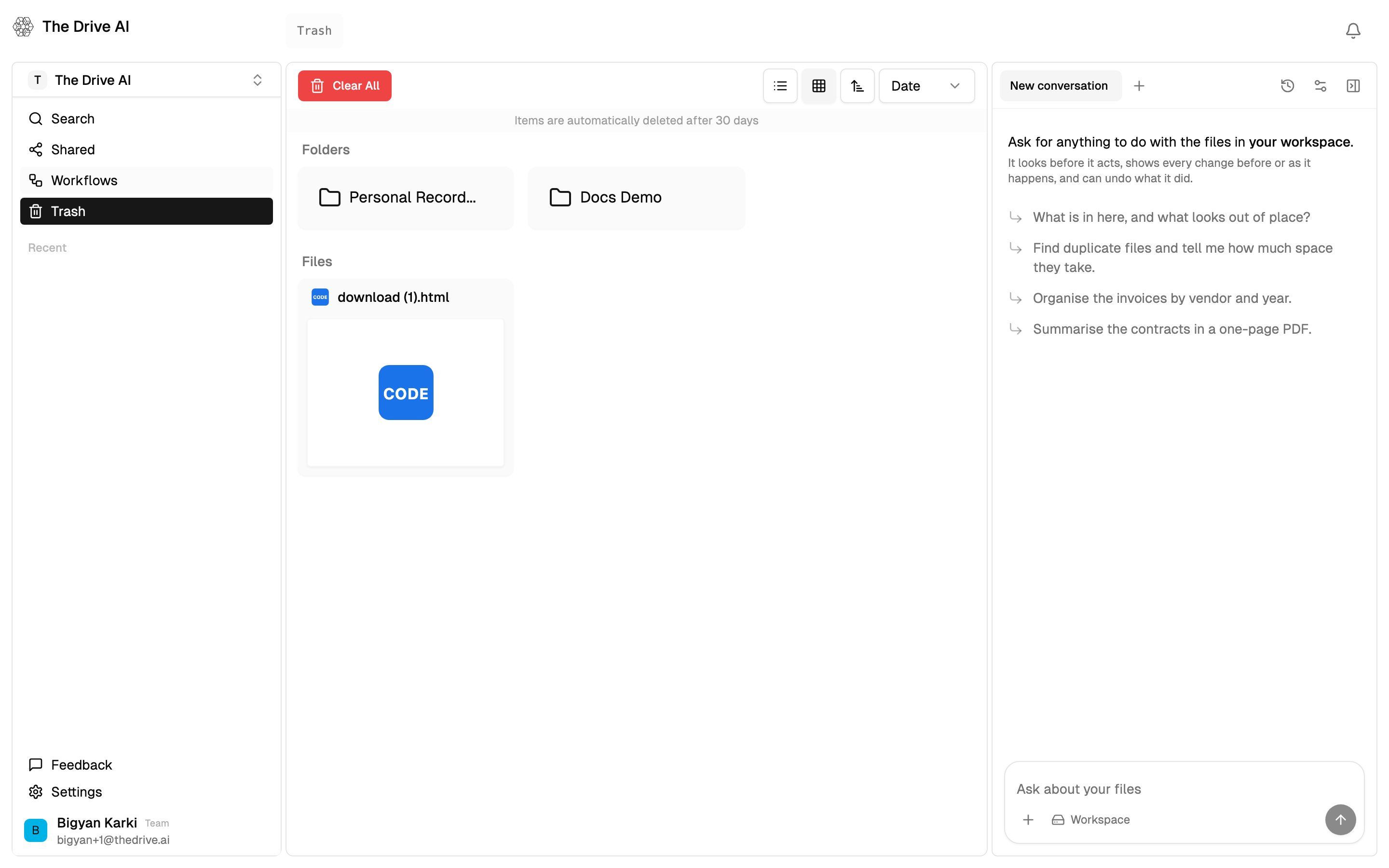
Restore
Point at an item at the top level of the Trash and click Restore, or select several and click Restore in the bar at the bottom. The item goes back to the folder it was deleted from, with everything that was deleted along with it, and The Drive AI reads it again so you can search it and the agent can work with it. Files you deleted from the folder on their own, before you deleted the folder, stay in the Trash; restore them separately. Items inside a deleted folder can’t be restored on their own. Restore the folder. You can also ask the agent to undo a delete it made.Delete permanently
- One item: point at it and click Delete Permanently.
- Several: select them and click Delete Permanently in the bar at the bottom.
- Everything: click Clear All.
Automatic deletion after 30 days
Anything in the Trash for more than 30 days is permanently deleted automatically, overnight. To keep something, restore it before then.What permanent deletion also removes
When a file is permanently deleted:- Its versions are deleted with it.
- Its sharing is removed, and its public link stops working.
- A signature request you were still preparing (a draft) for it is deleted.
- A signature request that was sent but not finished is voided, and signers’ links say so. See E-signatures.
- A completed signature request keeps its record and signed copy. Its history isn’t lost.
- Its activity history is kept in the workspace’s activity log.
What’s next?
Approving and undoing
Undo a change the agent made.
Browsing and search
Find, move and organize your files.