

Overview
After a trigger picks up a file, steps decide what happens to it. There are two kinds:- Decisions send each file down a path: by the file’s details, by AI reading it, or by a person.
- Actions do something: move, rename, read details, save a copy, send a message and more.
Steps with no label are instant and exact.
How files flow
- Every file that reaches a step goes through it. Only decisions choose between paths.
- A decision has one exit per path. Leave an exit unconnected and files that take it stop there, untouched. That’s how you say “leave everything else alone”.
- Each action has one next step. When two paths need the same action, give each path its own copy of the step.
- Move and rename act wherever the file is: in The Drive AI, or in the connected account it came from.
Decisions
Check File Details
Sends files down different paths by what’s already known about them: type, age, size, name or location. No AI, so it’s instant, free and exact. Use it instead of Ask AI About the File whenever the question doesn’t need the file’s contents.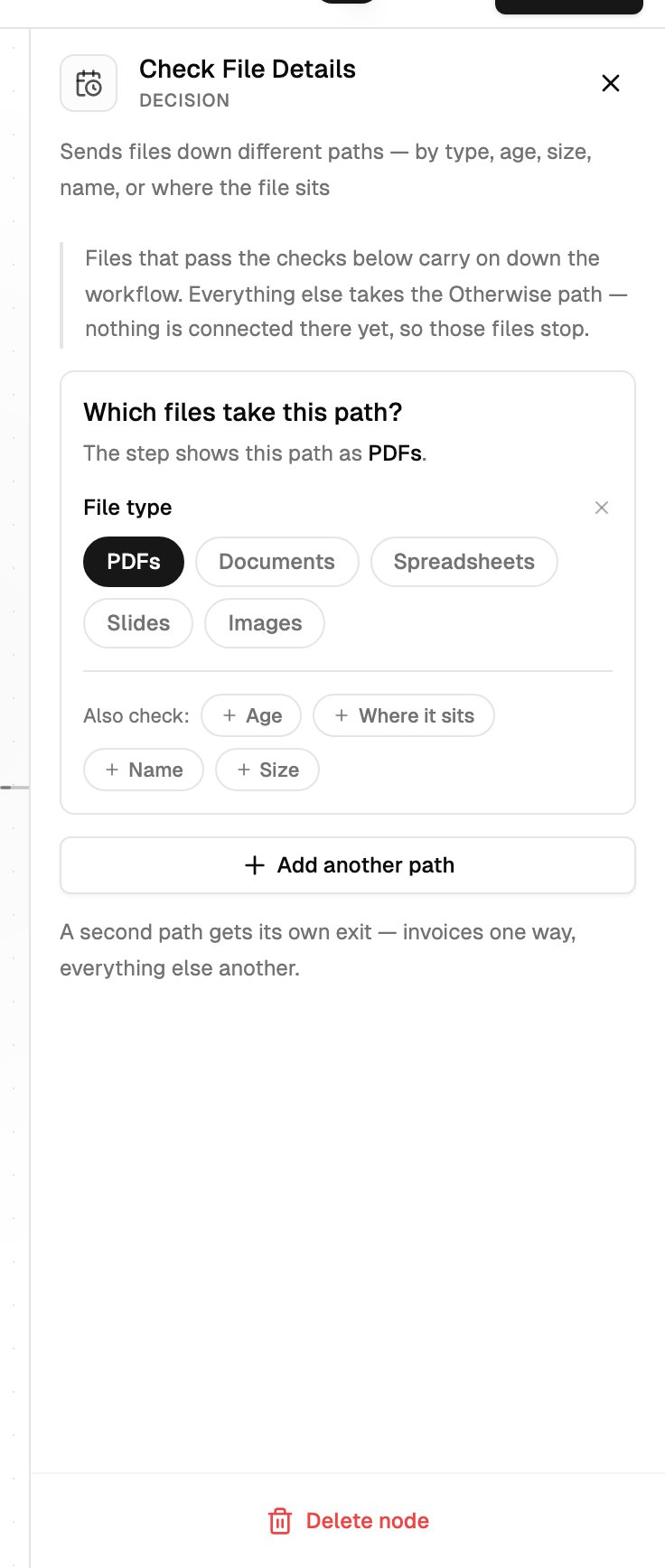
The panel shows how each path is labelled on the canvas, in plain words.
- Age needs files with a stored date, so it doesn’t work with email attachments.
- Where it sits needs an On a Schedule source. For other sources, narrow the source’s folder instead.
- A path with no checks matches every file. The panel warns you.
Ask AI About the File
AI reads the file and answers your question, then sends the file down the path for that answer.- What should this step check?: ask about what the file says, for example “Is this contract fully signed?”
- Possible answers: the exits. They start as
yesandno; rename them or click Add for more, likeinvoice,receipt,contract.
other last.
Example: “What kind of document is this?” with answers invoice, receipt, other. Invoices go to a Move step, receipts to a Rename step, and other is left unconnected.
Ask a Person to Approve
Pauses the run and asks a person before anything after it happens. Put it before the steps it guards.
The step has three exits: Approved, Rejected and Expired. A rejected or expired file stops and stays where it is, unless you connect that exit to another step, for example a Move into a Review folder.
With Only when unsure, confident filing into existing folders goes ahead on its own and is logged. New folders, unsure matches and anything destructive still ask.
Approvers are emailed and notified in the app. If you pick Specific people but don’t choose anyone, admins are asked instead. Owners and admins can also decide approvals addressed to specific people.
Example: Check File Details (older than 1 year) → Ask a Person to Approve (“Delete this old file?”) → Approved to Move to Trash, Rejected to Move into Archive.
An approver can add a note when deciding. The note steers the steps that take instructions after the approval, like Move, Rename and Read Details from File. It can’t change Move to Trash. See Approvals and activity.
Actions that read the file
These steps take an instruction in plain words. The AI reads each file and works out the rest. End an instruction with two or three examples, written as “this → that”, for the most reliable results.Move
Moves the file to a folder. Under Where should this file go?, describe where, for example “to the client’s folder, then by year”. Folders that don’t exist yet are created. Describe where each value comes from in the document, and only the folder levels you want. “To the client’s folder, from the party named on the invoice, then by year from the invoice date” works better than “by client and year”. Under More options, If the same file is already there decides what happens when a file with identical content is already in the destination:- Move it anyway: renamed if the name is taken. This is the default.
- Leave it where it is.
- Set it aside for review: filed into a Possible Duplicates folder.
Rename
Renames the file. Under What should this file be named?, describe the name, for example “with client name and invoice number”. Example: “date, client and invoice number. e.g. invoice INV-10422 from Acme Corp dated 12 Mar 2026 → 2026-03-12 Acme Corp INV-10422.pdf”Read Details from File
Pulls values out of the file, like vendor, amount or due date, without moving or renaming it. Under What data should be extracted?, say what to read. Under Values later steps can use, name each value and choose its type: Text, Number, Yes / no or List. Named values can be dropped into later steps’ messages, questions and instructions. Without names, the values only appear in the run’s activity. You don’t need this step just to file or rename by a value: Move and Rename read the file themselves. Use it when you want the values in a message, an approval question or another app, or when the same value must appear in two places. Example: readvendor and amount, then Send a Message to Slack with a message like “Invoice from” followed by the vendor value, “for”, and the amount value.
Split Document
Splits one file into several, for example a scanned stack into separate invoices. Under How should the document be split?, describe it, for example “split into separate invoices” or “split every 5 pages”. The parts are saved next to the original, and each part continues through the rest of the workflow on its own. Under More options, The original, once split can be Stays where it is, Goes to trash or Goes to a folder.Merge Files
Combines several files that arrive together into one, for example all the exhibits attached to one email. Under How should files be merged?, describe the order, for example “combine into one PDF, ordered by date”. It only combines files from the same arrival, like one email’s attachments or the parts of a split. Files that arrive separately over time aren’t held together.Actions that store or remove files
Save a Copy
Puts a copy of the file in The Drive AI or in a connected Google Drive, OneDrive, SharePoint or Dropbox account. The original is never moved or deleted.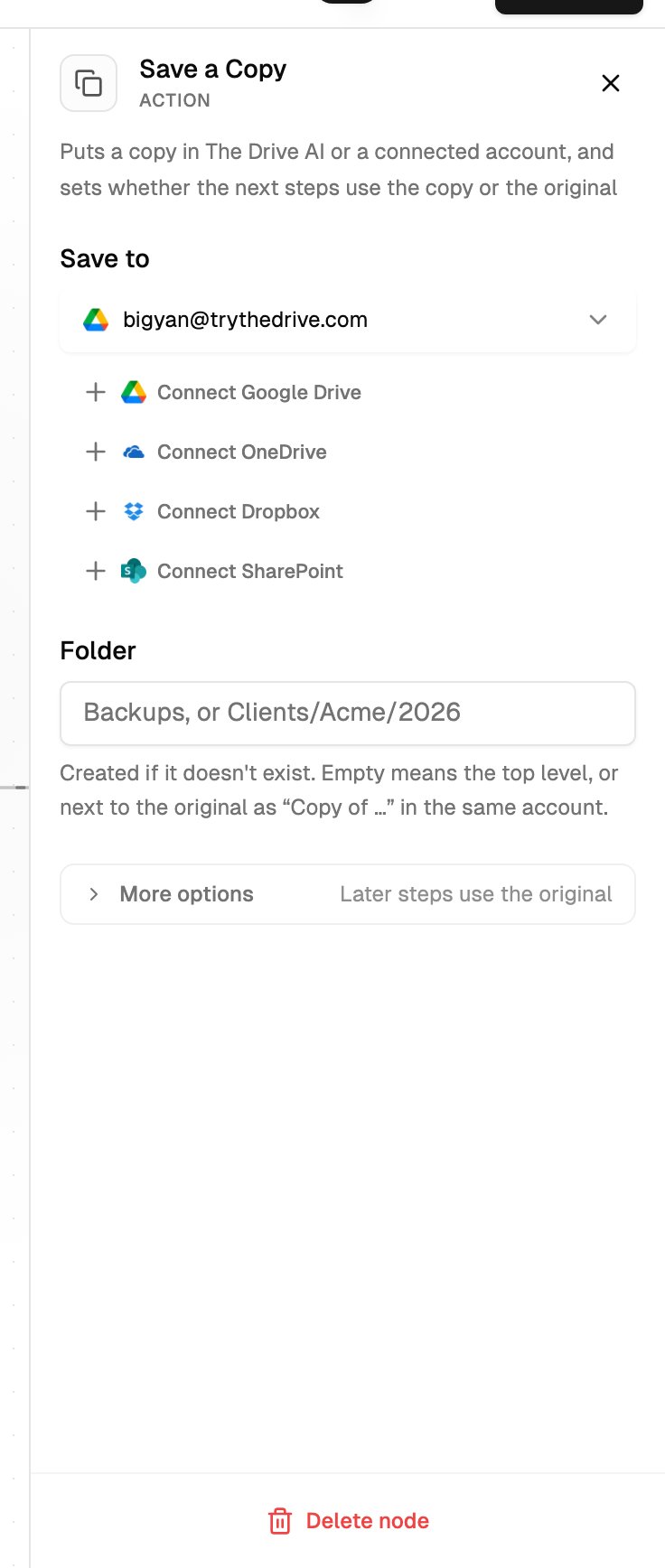
To pick a SharePoint site and library, you need your own SharePoint account connected in Settings > Integrations.
If the file is already in that exact account, nothing is copied and the workflow carries on with the file.
Email Attachment, Slack and Microsoft Teams sources need Save a Copy as their first step, set to The copy, because those files aren’t stored anywhere until then.
Example: Email Attachment → Save a Copy to Google Drive, folder
Inbox, The copy → Move “to the client’s folder”.
Move to Trash
Moves the file to the trash, where it can still be recovered. There’s nothing to set up, and nothing runs after it, so use it at the end of a path. Pair it with Check File Details or Ask AI About the File so only the files you mean reach it, and consider Ask a Person to Approve first.Actions that tell someone
Send a Message
Sends a message without changing the file. Under Send this as, choose:- A Slack message: pick the Workspace and one Channel. Slack has to be connected in Settings > Integrations.
- An email: enter To and Subject.
Send to Another App
Sends the file’s details to another tool you use, such as your accounting system, at an address that tool gives you.- Address: the web address to send to. Required.
- More options > Method: POST unless the other app asks for PUT or PATCH.
- More options > Key: No key needed, Bearer token or API key (X-API-Key header), then enter the token or key.
- More options > Body: leave blank to send the standard details, or write your own, using values from earlier steps.
Using values from earlier steps
Text settings like messages, approval questions, move and rename instructions and the Send to Another App body can include values filled in at run time. Click a value under the field to insert it.
With several sources, only values every source has are offered. Source says which one the file came from, like Google Drive or The Drive AI.
What’s next?
Building with the agent
Describe the steps in words and let the agent wire them.
Approvals and activity
Follow each file through its steps.