> ## Documentation Index
> Fetch the complete documentation index at: https://docs.thedrive.ai/llms.txt
> Use this file to discover all available pages before exploring further.
# Conversations
> Work with several agent conversations at once: tabs, history, alerts when one needs you, questions, stopping and continuing, attachments, and what the agent sees
## Overview
Each request you make to the [agent](/agent/overview) lives in a conversation. You can keep several open as tabs, switch between them while they work, and find older ones in **History**.
Your conversations are private. Other members of the workspace can't see them, and each workspace has its own list.
 ## Conversation tabs
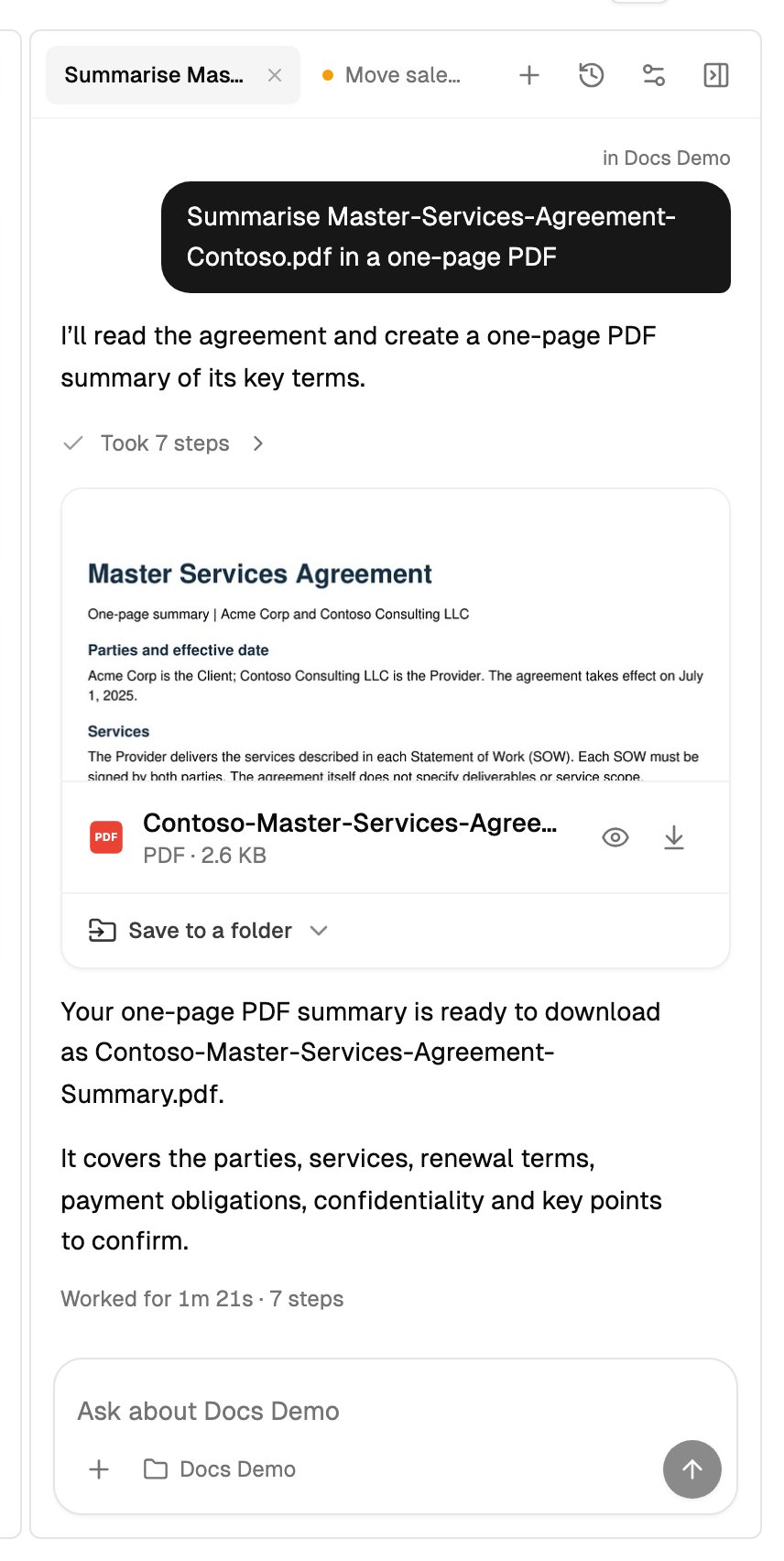
The open conversations are tabs across the top of the agent panel. The highlighted tab is the one you're looking at.
* **Start a new conversation.** Click **+** (**New conversation**). If you're already in a new, empty conversation, there's nowhere new to go.
* **Switch.** Click a tab. Press `⌘⇧]` and `⌘⇧[` (Mac) or `Ctrl+Shift+]` and `Ctrl+Shift+[` (Windows) to step through the tabs.
* **More tabs than fit.** The rest gather under **+N**. Click it to see them. Its dot shows the most urgent status among them.
* **Close a tab.** Point at it and click **×**. The conversation isn't deleted: it stays in **History**. You can't close a tab while the agent is still working in it.
Switching tabs or starting a new conversation doesn't stop anything. A conversation you leave keeps working, and its tab shows how it's going. Each conversation keeps its own unsent message and attachments.
A conversation that's working, needs you, or finished while you were away appears as a tab even if you closed it, so nothing new is out of sight.
### Status dots
A dot on a tab, and on each conversation in **History**, shows what it's doing. Point at a tab to see the word.
| Dot | Status | Meaning |
| - | - | - |
| Blue, pulsing | **Working** | The agent is working on it. |
| Amber | **Needs you** | It's waiting for your approval or an answer, or it stopped at its size limit and can keep going. |
| Green | **Finished** | It finished while you were elsewhere. |
| Red | **Stopped** | It stopped before it finished. |
### Several at once
You can have up to 3 conversations working at the same time. A conversation that's waiting on you doesn't count toward that. If you try to start a fourth, the agent asks you to wait for one to finish or stop it.
## History
Click **History** (the clock icon) in the panel's header to see all your conversations in this workspace.
* **Search.** Type in **Search conversations**. It matches the words in conversation titles.
* **Groups.** Conversations are grouped by when they were last active: **Today**, **Yesterday**, **Previous 7 days**, **Previous 30 days** and **Older**.
* **Open one.** Click it. It opens as a tab.
* **Rename.** Point at a conversation and click the pencil. Type a name and press `Enter`. A conversation you don't rename is named after your first message.
* **Archive.** Point at a conversation and click the archive icon. Archived conversations leave your list and never appear as tabs. Stop a conversation before you archive it.
* **See archived conversations.** Click **Show archived** at the bottom of the list. They appear under **Archived**, where you can unarchive one. Click **Hide archived** to put them away again.
## When a conversation needs you
You don't have to watch a conversation while it works. The agent tells you when one needs you or finishes.
**While the panel is closed**, the **Agent** button in the toolbar shows an amber number: how many conversations need you. Point at it to read, for example, "Show agent · 2 conversations need you". While one is working and none needs you, the button shows a pulsing dot instead.
**While you're on another conversation or page**, a message appears in the corner of the screen, such as "Tidy invoices needs your approval". Click **Open** to go straight to that conversation, even if it's in another workspace. You get one message per conversation; a newer status replaces it.
| Message ends with | What happened |
| - | - |
| **needs your approval** | A change or action is waiting for you to allow it. |
| **has a question** | The agent asked you something. |
| **can keep going** | The task grew bigger than one turn and stopped. Open it and say "continue". |
| **finished** | It's done. |
| **stopped** | It stopped before it finished. |
You don't get a message for the conversation you're reading.
**While you're in another tab or app**, your computer can show a notification instead, if you allow browser notifications for The Drive AI. Turn them on in **Settings** > **Notifications** with **Browser alerts** and the **Assistant** topic. If you haven't allowed them, the message waits and appears when you come back. See [Notifications](/account/notifications).
## Answering the agent's questions
When the agent needs to know something, it asks in a **Question** card marked **Needs an answer**.
* Click one of the suggested answers, or
* Type your own in **Or say it your way** (or **Type an answer**) and click **Send**.
The conversation continues from your answer. Afterwards the card shows **Answered** and what you said. While a question is waiting, you can't send from the message box at the bottom (it says **Answer the question above to continue**): answer in the card.
Answering a question doesn't count as a task.
## Stop and continue
**Stop.** While the agent is working, the send button becomes a square **Stop** button. Click it to stop the task. The conversation shows **Stopped.** A task you stop still counts.
Stopping doesn't undo changes the agent already applied. Use **Undo** on their cards. See [Approving and undoing](/agent/approving-and-undoing).
**Continue.** If a task grows bigger than one turn, the agent stops and says: "This task got bigger than one turn can finish, so I stopped here. Say "continue" and I'll pick up where I left off." Type "continue" to carry on. Continuing counts as a new task. How big one turn may be is the workspace's [task size](/agent/settings#task-size).
If the agent had already made files, such as a half-built spreadsheet, it attaches them to the chat before it stops, marked **Unfinished: the task stopped before this was checked**, and says it attached what it had made so far. When you say "continue", it builds on those files instead of starting over. It attaches up to 10 files this way.
On the Free plan, if you can change the plan, the stop message also links to the next plan up: "On *plan*, bigger tasks finish in one go."
If the agent couldn't make progress three times in a row, it stops and asks you to say "continue" to try again.
## What you see while it works
* **Steps.** Each thing the agent looks at or does shows as one short line, such as reading a folder. Several steps fold into one line, like "Took 12 steps". Click a line to open it.
* **Plan.** For bigger requests, the agent may write a short plan. Click **Plan** to read it.
* **Cards.** Changes, actions, questions and files appear as cards. See [Approving and undoing](/agent/approving-and-undoing).
* **Cards that take you somewhere.** When something needs a screen of its own, like connecting a drive or upgrading, the agent shows a card with one button that opens it. A card marked **Needs an admin** tells you who can do it.
* **When it's done**, a line under the answer says how long it worked and how many steps it took.
Each message you send shows where you were when you sent it, such as "in Invoices" or "viewing contract.pdf", whenever that changed.
## Attach files
Attach files to give the agent something that isn't in your workspace, like a document from your computer.
Click **+** (**Attach a file**) next to the message box and choose files, or drag files onto the panel and drop them on **Drop to attach to this conversation**.
Each file shows its upload progress above the message box. Once it's uploaded, click it to preview it. Click **×** on a file to remove it before you send. A file that couldn't upload says **failed**.
Say what to do with them, for example "Compare these two quotes." You can send attachments without any text.
**Limits:**
* Up to 10 files per message.
* Up to 25 MB per file.
* Up to 200 attachments in one conversation.
* Attachments are kept for 30 days, then they expire from the conversation.
Attached files belong to the conversation only. They aren't saved to your workspace. To keep one, ask the agent to save it into a folder.
For files the agent makes and how to save them, see [Document creation](/features/document-creation#getting-the-file).
## What the agent sees
The agent works from where you are when you send each message. A chip next to the message box shows it:
* **A folder name**: you're in that folder. The agent treats it as "here".
* **A file name**: you have a file open, for example a PDF in the viewer. The agent treats that file as "this", and its folder as "here". Ask "summarize this" or "what's the total on this invoice?" without naming the file.
* **Workspace**: you're at the top level.
Point at the chip to see what "here" or "this" means right now. To change it, open another folder or file. You don't need to start a new conversation.
A new conversation also lists any [connected drives](/agent/connected-drives) the agent can reach, under **Also sees**. A drive still being catalogued says **(cataloguing)**, and one with a problem says **(needs attention)**.
## Hide the agent
Click **Hide agent** in the panel's header, or press `⌘J` (Mac) or `Ctrl+J` (Windows). Nothing stops: conversations keep working, and the **Agent** button tells you when one needs you. Press the shortcut or click **Agent** to bring the panel back.
In the [browser extension](/agent/browser-extension), close Chrome's side panel instead.
## Troubleshooting
The agent may be waiting for you to answer a question card, or a file is still uploading. If the agent is turned off for the workspace, the panel says so.
You can have 3 conversations working at once. Wait for one to finish, or open it and click **Stop**.
"The assistant is busy right now. Try again in a little while." Nothing is wrong with your account. Send your message again in a few minutes.
Check that it's 25 MB or smaller and that the message has 10 files or fewer.
Turn on **Browser alerts** and the **Assistant** topic in **Settings** > **Notifications**. If your browser blocked notifications for the site, allow them in the browser's settings first.
## What's next?
Every card the agent shows, and how to undo a change.
Teach the agent how you like things done.
This documentation is built and hosted on [Mintlify](https://mintlify.com), a developer documentation platform.
## Conversation tabs
The open conversations are tabs across the top of the agent panel. The highlighted tab is the one you're looking at.
* **Start a new conversation.** Click **+** (**New conversation**). If you're already in a new, empty conversation, there's nowhere new to go.
* **Switch.** Click a tab. Press `⌘⇧]` and `⌘⇧[` (Mac) or `Ctrl+Shift+]` and `Ctrl+Shift+[` (Windows) to step through the tabs.
* **More tabs than fit.** The rest gather under **+N**. Click it to see them. Its dot shows the most urgent status among them.
* **Close a tab.** Point at it and click **×**. The conversation isn't deleted: it stays in **History**. You can't close a tab while the agent is still working in it.
Switching tabs or starting a new conversation doesn't stop anything. A conversation you leave keeps working, and its tab shows how it's going. Each conversation keeps its own unsent message and attachments.
A conversation that's working, needs you, or finished while you were away appears as a tab even if you closed it, so nothing new is out of sight.
### Status dots
A dot on a tab, and on each conversation in **History**, shows what it's doing. Point at a tab to see the word.
| Dot | Status | Meaning |
| - | - | - |
| Blue, pulsing | **Working** | The agent is working on it. |
| Amber | **Needs you** | It's waiting for your approval or an answer, or it stopped at its size limit and can keep going. |
| Green | **Finished** | It finished while you were elsewhere. |
| Red | **Stopped** | It stopped before it finished. |
### Several at once
You can have up to 3 conversations working at the same time. A conversation that's waiting on you doesn't count toward that. If you try to start a fourth, the agent asks you to wait for one to finish or stop it.
## History
Click **History** (the clock icon) in the panel's header to see all your conversations in this workspace.
* **Search.** Type in **Search conversations**. It matches the words in conversation titles.
* **Groups.** Conversations are grouped by when they were last active: **Today**, **Yesterday**, **Previous 7 days**, **Previous 30 days** and **Older**.
* **Open one.** Click it. It opens as a tab.
* **Rename.** Point at a conversation and click the pencil. Type a name and press `Enter`. A conversation you don't rename is named after your first message.
* **Archive.** Point at a conversation and click the archive icon. Archived conversations leave your list and never appear as tabs. Stop a conversation before you archive it.
* **See archived conversations.** Click **Show archived** at the bottom of the list. They appear under **Archived**, where you can unarchive one. Click **Hide archived** to put them away again.
## When a conversation needs you
You don't have to watch a conversation while it works. The agent tells you when one needs you or finishes.
**While the panel is closed**, the **Agent** button in the toolbar shows an amber number: how many conversations need you. Point at it to read, for example, "Show agent · 2 conversations need you". While one is working and none needs you, the button shows a pulsing dot instead.
**While you're on another conversation or page**, a message appears in the corner of the screen, such as "Tidy invoices needs your approval". Click **Open** to go straight to that conversation, even if it's in another workspace. You get one message per conversation; a newer status replaces it.
| Message ends with | What happened |
| - | - |
| **needs your approval** | A change or action is waiting for you to allow it. |
| **has a question** | The agent asked you something. |
| **can keep going** | The task grew bigger than one turn and stopped. Open it and say "continue". |
| **finished** | It's done. |
| **stopped** | It stopped before it finished. |
You don't get a message for the conversation you're reading.
**While you're in another tab or app**, your computer can show a notification instead, if you allow browser notifications for The Drive AI. Turn them on in **Settings** > **Notifications** with **Browser alerts** and the **Assistant** topic. If you haven't allowed them, the message waits and appears when you come back. See [Notifications](/account/notifications).
## Answering the agent's questions
When the agent needs to know something, it asks in a **Question** card marked **Needs an answer**.
* Click one of the suggested answers, or
* Type your own in **Or say it your way** (or **Type an answer**) and click **Send**.
The conversation continues from your answer. Afterwards the card shows **Answered** and what you said. While a question is waiting, you can't send from the message box at the bottom (it says **Answer the question above to continue**): answer in the card.
Answering a question doesn't count as a task.
## Stop and continue
**Stop.** While the agent is working, the send button becomes a square **Stop** button. Click it to stop the task. The conversation shows **Stopped.** A task you stop still counts.
Stopping doesn't undo changes the agent already applied. Use **Undo** on their cards. See [Approving and undoing](/agent/approving-and-undoing).
**Continue.** If a task grows bigger than one turn, the agent stops and says: "This task got bigger than one turn can finish, so I stopped here. Say "continue" and I'll pick up where I left off." Type "continue" to carry on. Continuing counts as a new task. How big one turn may be is the workspace's [task size](/agent/settings#task-size).
If the agent had already made files, such as a half-built spreadsheet, it attaches them to the chat before it stops, marked **Unfinished: the task stopped before this was checked**, and says it attached what it had made so far. When you say "continue", it builds on those files instead of starting over. It attaches up to 10 files this way.
On the Free plan, if you can change the plan, the stop message also links to the next plan up: "On *plan*, bigger tasks finish in one go."
If the agent couldn't make progress three times in a row, it stops and asks you to say "continue" to try again.
## What you see while it works
* **Steps.** Each thing the agent looks at or does shows as one short line, such as reading a folder. Several steps fold into one line, like "Took 12 steps". Click a line to open it.
* **Plan.** For bigger requests, the agent may write a short plan. Click **Plan** to read it.
* **Cards.** Changes, actions, questions and files appear as cards. See [Approving and undoing](/agent/approving-and-undoing).
* **Cards that take you somewhere.** When something needs a screen of its own, like connecting a drive or upgrading, the agent shows a card with one button that opens it. A card marked **Needs an admin** tells you who can do it.
* **When it's done**, a line under the answer says how long it worked and how many steps it took.
Each message you send shows where you were when you sent it, such as "in Invoices" or "viewing contract.pdf", whenever that changed.
## Attach files
Attach files to give the agent something that isn't in your workspace, like a document from your computer.
Click **+** (**Attach a file**) next to the message box and choose files, or drag files onto the panel and drop them on **Drop to attach to this conversation**.
Each file shows its upload progress above the message box. Once it's uploaded, click it to preview it. Click **×** on a file to remove it before you send. A file that couldn't upload says **failed**.
Say what to do with them, for example "Compare these two quotes." You can send attachments without any text.
**Limits:**
* Up to 10 files per message.
* Up to 25 MB per file.
* Up to 200 attachments in one conversation.
* Attachments are kept for 30 days, then they expire from the conversation.
Attached files belong to the conversation only. They aren't saved to your workspace. To keep one, ask the agent to save it into a folder.
For files the agent makes and how to save them, see [Document creation](/features/document-creation#getting-the-file).
## What the agent sees
The agent works from where you are when you send each message. A chip next to the message box shows it:
* **A folder name**: you're in that folder. The agent treats it as "here".
* **A file name**: you have a file open, for example a PDF in the viewer. The agent treats that file as "this", and its folder as "here". Ask "summarize this" or "what's the total on this invoice?" without naming the file.
* **Workspace**: you're at the top level.
Point at the chip to see what "here" or "this" means right now. To change it, open another folder or file. You don't need to start a new conversation.
A new conversation also lists any [connected drives](/agent/connected-drives) the agent can reach, under **Also sees**. A drive still being catalogued says **(cataloguing)**, and one with a problem says **(needs attention)**.
## Hide the agent
Click **Hide agent** in the panel's header, or press `⌘J` (Mac) or `Ctrl+J` (Windows). Nothing stops: conversations keep working, and the **Agent** button tells you when one needs you. Press the shortcut or click **Agent** to bring the panel back.
In the [browser extension](/agent/browser-extension), close Chrome's side panel instead.
## Troubleshooting
The agent may be waiting for you to answer a question card, or a file is still uploading. If the agent is turned off for the workspace, the panel says so.
You can have 3 conversations working at once. Wait for one to finish, or open it and click **Stop**.
"The assistant is busy right now. Try again in a little while." Nothing is wrong with your account. Send your message again in a few minutes.
Check that it's 25 MB or smaller and that the message has 10 files or fewer.
Turn on **Browser alerts** and the **Assistant** topic in **Settings** > **Notifications**. If your browser blocked notifications for the site, allow them in the browser's settings first.
## What's next?
Every card the agent shows, and how to undo a change.
Teach the agent how you like things done.
This documentation is built and hosted on [Mintlify](https://mintlify.com), a developer documentation platform.